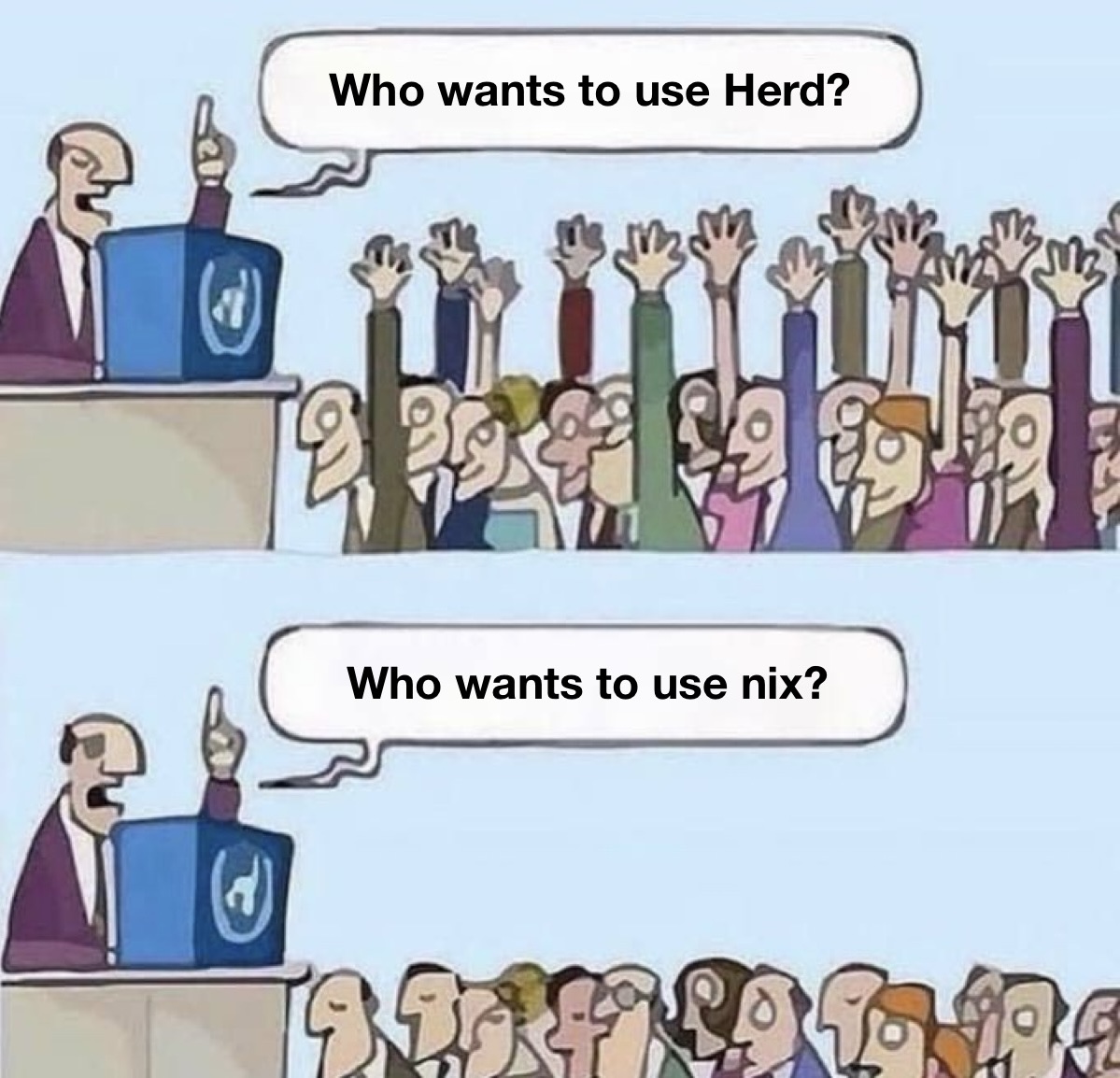
I've been on a spiritual journey this past year or so really tinkering with my dev workflow and spending an alarming amount of time in dotfiles tweaking this or that. It started off with tmux a couple years ago and multiple failures to launch trying to get myself using neovim. Once I got to the point where I physically couldn't leave my terminal (cue the "stuck in vim" memes), I moved onto finding terminal replacements for tools I use and pay for (most of the time, happily). A few notable ones:
I'm happy with my setup that I've fine tuned for Laravel and PHP, but I wanted to take it one step farther and see if I could home grow a Herd replacement to save yet another subscription. I should preface that you should use, and happily pay for, Herd. It's hands down the best Laravel/PHP get-your-project-off-the-ground tool out there right now (imo). You can fiddle with Docker containers, tweak volume paths, rage at how much storage Docker is filling up on your machine, etc. though Herd is a one-time install that removes all the noise so you can focus on building stuff.
With that said, Herd can have some rough edges.
One of the things I've really embraced since letting Claude run my life help manage my workflow
is a worktree-first mindset allowing multiple agents to work on multiple things at once without
stepping on each other's robot toes. I even wrote about getting Herd setup for worktrees with the help of worktrunk, another tool I've been
evangelizing to whoever will listen to me yap about it. While it's a fine solution (I think, at least),
it can always be made better. For example, your worktree setup has to know about Herd linking, which
configures nginx sites for you under the hood. That's global state as Herd has to run dnsmasq as root
to allow the use of portless .test domains. That's all fine, but a bit against the ethos of isolated
environments that worktrees aim to provide.
Another thing is global state, particularly with PHP and the associated services. In my experience, Herd can often step on its own toes when spinning up services like FPM for specific versions of PHP. If you're working on multiple projects across multiple PHP versions, or maybe the same project, but in a branch/worktree that's upgrading a PHP version, you might run into port contention at some point and have to do a round of process massacre to get back to a stable state. This compounds when running multiple versions of PHP FPM as well, where the port contention can become painful sometimes with a handful of worktrees running concurrently.
These are not Herd's fault at all. This is a result of trying to wrangle processes all in coordination on a machine, which has been a thorn in the side of developers for as long as professional programming has been a thing.
There's alternatives, though. And one alternative I've been particularly keen on is nix with devenv.
Going Herd-less
One of the great things Herd does is manage services like Redis, your databases (MySQL, Postgres, etc.), Typesense, mail, and a whole litany of stuff. Pretty much anything you need to run an app, Herd has a managed process for it. One thing that I don't particularly love about Herd, though, is how these services are somewhat obfuscated from you and abstracted away. And rightfully so. I mean, we're building apps and writing code (lmao, no we're not). I don't always want to deal with setting up databases and making sure Redis is running. That's where Herd is excellent for the DX, managing the stuff I don't really care about.
But sometimes, I do care about it. And the older I get, the more "control freak" I become where I want to know exactly what's running in my dev environment at all times and how I can manage it.
That's where nix comes in. I won't go into much detail as I'm still a nix noob myself, but for what I'm using it for, I can't see a world where I go back.
Nix provides a framework for declarative system builds for whatever you need. It's like a composer.json or
package.json file but for your machine environment. You tell nix via devenv that for a particular project you need PHP,
a specific version of it, what extensions you need, what database you need running, what version of Redis, etc.
You probably get the picture, but the biggest win is that these are defined in a file that you can version control,
tweak, manage, remove things, add services and tools, and anything else your project needs in its
environment to run. This alone is the perfect marriage for worktrees, where a worktree exists in complete
isolation from other worktrees where I'm free to tinker with its environment if I need to without affecting
any other worktree. For example, if I'm doing a PHP 8.3 to PHP 8.4 upgrade, I keep main declaratively
pinned to 8.3, while my feature/update-php-to-8.4 worktree branch pins itself to 8.4 with maybe a few
extra extensions and some php.ini tweaks and I can run both simultaneously in parallel without any headache.
You can absolutely still do this in Herd. There's a few gotchas, though it's still doable (read the other blog post!)
Devenv is a layer that sits atop nix that makes it ridiculously simple to declare
what your project and environment needs to hit the ground running. All managed in a single devenv.nix file.
The real power here with devenv comes to light when taking a bare repository layout to your repository. What this means is instead of version controlled
project existing in a single folder where its .git/ directory lives within the repository folder itself,
you move .git/ up a level as a sibling folder. This is perfect for worktree-driven development, as .git/
is global repository state, and all linked worktrees are just folders within a parent project folder. In practice,
this looks like:
my-awesome-project/
  .git/
  main/
  feature-foo-bar/
  fix-foo-baz/
Where git switch now becomes cd into whatever branch/worktree I need to be on. The git state is managed
globally among the worktrees, and there's no need for a dedicated worktrees folder where you might store
your worktrees.
Rewiring the ole noggin a bit, this approach to a project's version control goes hand-in-hand with devenv, where each folder now gets its own runtime environment, from services, tools, secrets, etc.
But we're not exactly Herd-less yet. While devenv manages the things we need to run our apps, we still need to see the dang thing run in a browser. That's where Caddy comes in.
Not your dad's web server
Caddy is the spiritual successor to nginx. It's fast, has a bunch of modern features, an nginx-like DSL,
written in Go, etc. I'm not a caddy expert, I just need local reverse proxying. That's what caddy helps
accomplish akin to how Herd uses nginx to forward those my-awesome-project.test requests to the correct
running instance of the app locally. For example, the caddy file for my website here looks like this:
joeymckenzie.tech.test.caddy
joeymckenzie.tech.test {
  reverse_proxy 127.0.0.1:8100
}

assets.joeymckenzie.tech.test {
  reverse_proxy 127.0.0.1:5273
}
I keep all my caddy sites in my ~/.config/caddy/sites folder and wire them up in a Caddyfile that nix
declaratively manages for me, like so:
~/.config/nix-darwin/darwin/services.nix
environment.etc."caddy/Caddyfile".text = ''
  {
    local_certs
  }

  import /Users/${username}/.config/caddy/sites/*.caddy
'';
I'm telling nix here that my system, when I build it, needs a Caddyfile running within /etc that
nix generates when I build my system. I'm glossing over a ton of details here, namely nix-darwin
and home-manager for declaratively managing my MacBook Pro,
but I promise I'll write about those soon. In the meantime, you can poke around my nixfiles if
you want to see the full setup. Skimming over the finer details, what this looks like in my
system declaration where I tell nix what services I want launched as background processes when I build is:
launchd.daemons.caddy = {
  serviceConfig = {
    ProgramArguments = [
      "${pkgs.caddy}/bin/caddy"
      "run"
      "--config"
      "/etc/caddy/Caddyfile"
      "--adapter"
      "caddyfile"
    ];
    RunAtLoad = true;
    KeepAlive = true;
    EnvironmentVariables = {
      HOME = "/var/root";
      XDG_CONFIG_HOME = "/var/root/.config";
      XDG_DATA_HOME = "/var/root/.local/share";
    };
    StandardOutPath = "/var/log/caddy.out.log";
    StandardErrorPath = "/var/log/caddy.err.log";
  };
};
Now when I rebuild my system via nix-darwin, caddy launches in the background and I have full access
to the caddy CLI to do whatever I need. More importantly, because I'm launching caddy as a background
process from the root, I get access to ports :80 and :443, so I can run my Laravel apps from a TLD without
specifying a port that it needs to run on. This is essentially what Herd does, but with nginx instead.

Now the other side of the coin: dnsmasq.
I wire caddy up so that it knows that any caddy file setup in ~/.config/caddy/sites needs reverse proxying.
I'll get into how exactly I do that in a bit, but the important information is that caddy knows that there's
sites it needs forward requests to that run on my local machine. Something has to tell the browser though
that those requests actually need to go to 127.0.0.1, the artist also known as localhost.
With dnsmasq, requests from the browser to a TLD like .test will ask /etc/resolver/test where those
requests need to go. Dnsmasq answers that question with "to 127.0.0.1, my guy," and all is good in the world.
With dnsmasq directing browser requests and caddy acting as a reverse proxy, .test domains work exactly as
they do with Herd. I setup dnsmasq as another launch service so that when I (re)build my system with nix,
it starts up alongside caddy and I'm off to the races:
services.dnsmasq = {
  enable = true;
  addresses = {
    test = "127.0.0.1";
  };
};

environment.etc."resolver/test".text = ''
  nameserver 127.0.0.1
'';
Declarative nix files
Okay, that's enough networking for the week. Now to the fun stuff, actually running a dev environment for Laravel. For a full-fledged Laravel app, we need a few things going for us:
- We need PHP and JavaScript (obviously)
- We need environment variables
- We need queues, so Redis and maybe Horizon
- We need a database: MySQL, Postgres, SQLite, etc.
- We might want full-text search with meilisearch or typesense
- We might need feature flags with LaunchDarkly
- ...and any other service that our app needs to run
And that's where nix joins us once again, to set those things up for us in an isolated development shell, hidden from the outside world. The devenv docs will do a better job of getting you setup with nix and devenv than I ever will, so I highly encourage you to give them a quick once over.
Within a project, you can run devenv init to get a pretty bare bones setup for a devenv.nix file:
{ pkgs, lib, config, inputs, ... }:

{
  # https://devenv.sh/basics/
  env.GREET = "devenv";

  # https://devenv.sh/packages/
  packages = [ pkgs.git ];

  # https://devenv.sh/languages/
  # languages.rust.enable = true;

  # https://devenv.sh/processes/
  # processes.dev.exec = "${lib.getExe pkgs.watchexec} -n -- ls -la";

  # https://devenv.sh/services/
  # services.postgres.enable = true;

  # https://devenv.sh/scripts/
  scripts.hello.exec = ''
    echo hello from $GREET
  '';

  # https://devenv.sh/basics/
  enterShell = ''
    hello         # Run scripts directly
    git --version # Use packages
  '';

  # https://devenv.sh/tasks/
  # tasks = {
  #   "myproj:setup".exec = "mytool build";
  #   "devenv:enterShell".after = [ "myproj:setup" ];
  # };

  # https://devenv.sh/tests/
  enterTest = ''
    echo "Running tests"
    git --version | grep --color=auto "${pkgs.git.version}"
  '';

  # https://devenv.sh/git-hooks/
  # git-hooks.hooks.shellcheck.enable = true;

  # See full reference at https://devenv.sh/reference/options/
}
This is a basic devenv nix file. The nix DSL is pretty human friendly, but there's a whole language manual worth a lazy Sunday afternoon read. A nix file is basically a recipe to tell nix how to construct the development shell you'll be working in, declaring what languages, tools, and services you might need to get the project running.
That { pkgs, lib, config, inputs, ... }: block at the top of the file is an entry point for nix, of sorts,
that kind of acts like a function signature. This is saying "I need the nix built-in modules for pkgs, lib, config, and inputs",
where our recipe uses these to hook in the things we need.
The rest of the scope block, or the stuff in between the brackets, is just a recipe for how to build this dev shell. We assign an env var for the environment, wire up git as a tool for us to be able to use, build out some arbitrary scripts to execute, and some hooks for when we enter the dev shell that'll run some arbitrary commands as well as a hook for when we want to specifically run tests on this shell
Laravel-ization
Now we need to Laravel-ize it. I'm going to be using my fork
of the official Laravel/React starter kit to build up a devenv.nix file that allows us to run a Laravel app, so feel free to reference that file
anytime. I have a separate branch in feature/add-nix-support that I usually clone anytime I start a new project that inevitably doesn't go anywhere.
First, we get rid of everything so we can work from a clean slate.
For my setup, I only use pkgs and lib as the named arguments as I don't need config or inputs:
{ pkgs, lib, ... }:
Next, we need some variables to pass around for the app setup for the common things we'll be reusing:
{ pkgs, lib, ... }:

let
  # ─── Project identity ─────────────────────────────────────────────────
  # Kebab for hosts/Caddy site files, snake for Postgres identifiers
  # (which can't contain dashes without double-quoting at every callsite).
  appName = "laravel-official-react-starter-kit";
  appSlug = lib.replaceStrings [ "-" ] [ "_" ] appName;

  # ─── Worktree identity ────────────────────────────────────────────────
  worktreeName =
    let
      base = builtins.baseNameOf (toString ./.);
    in
    if base == appName then "main" else lib.toLower base;

  isPrimary = worktreeName == "main";

  # ─── Per-worktree slot allocation ─────────────────────────────────────
  #
  # Problem: running multiple git worktrees of this project at the same
  # time (e.g. `main` plus a feature branch) would have them fight over
  # the same TCP ports (php-fpm, vite), the same Postgres database name,
  # the same Redis DB number, and the same `.test` hostname. The second
  # `devenv up` either crashes on port-bind or silently corrupts the
  # first worktree's state.
  #
  # Solution: each worktree gets a stable integer slot (0-499) derived
  # from a hash of its directory name. That slot becomes a port offset
  # (phpPort = 8000 + slot, vitePort = 5173 + slot), a Redis DB index,
  # a database-name suffix, and a hostname prefix. The primary checkout
  # is always slot 0 / standard ports / unsuffixed names so it gets the
  # most ergonomic URLs.
  #
  # The slot is derived from a hash of the directory name (rather than
  # from a shared registry or by enumerating worktrees at eval time) so
  # it's stable across re-clones and needs no coordination between
  # worktrees. mod 500 keeps the birthday-collision probability under
  # ~9% across 10 active worktrees; if you draw the short straw, drop
  # any unused integer 1-499 into `.devenv-index` to pin the slot by
  # hand.
  #
  # Redis is the one special case: the daemon only ships with 64 DBs,
  # so the Redis slot mods by 63 instead. A collision there is harmless
  # because HORIZON_PREFIX further scopes the keyspace per worktree, so
  # two worktrees sharing a Redis DB index can coexist without keys
  # bleeding across.
  hexDigit =
    c:
    {
      "0" = 0;
      "1" = 1;
      "2" = 2;
      "3" = 3;
      "4" = 4;
      "5" = 5;
      "6" = 6;
      "7" = 7;
      "8" = 8;
      "9" = 9;
      "a" = 10;
      "b" = 11;
      "c" = 12;
      "d" = 13;
      "e" = 14;
      "f" = 15;
    }
    .${c};

  hashValue =
    let
      hex = builtins.substring 0 4 (builtins.hashString "sha256" worktreeName);
      chars = lib.stringToCharacters hex;
    in
    lib.foldl' (acc: c: acc * 16 + (hexDigit c)) 0 chars;

  hashIndex = (lib.mod hashValue 500) + 1;

  indexFile = ./.devenv-index;
  index =
    if isPrimary then
      0
    else if builtins.pathExists indexFile then
      lib.toInt (lib.removeSuffix "\n" (builtins.readFile indexFile))
    else
      hashIndex;

  redisDbIndex = if isPrimary then 0 else (lib.mod hashValue 63) + 1;

  # Per-worktree ports. Postgres/Redis/Caddy/Mailpit are nix-darwin daemons
  # on their standard ports, see ~/.config/nix-darwin/darwin/services.nix.
  phpPort = 8000 + index;
  vitePort = 5173 + index;

  # ─── Names + hosts ────────────────────────────────────────────────────
  dbName =
    if isPrimary then
      appSlug
    else
      "${appSlug}_" + lib.replaceStrings [ "-" "." "/" ] [ "_" "_" "_" ] worktreeName;

  appHost =
    if isPrimary then
      "${appName}.test"
    else
      "${worktreeName}.${appName}.test";

  # vite.config.ts should set `server.origin` to this and `server.hmr.host`
  # to this with `protocol = 'wss'` + `clientPort = 443` so HMR works over
  # HTTPS without mixed-content blocks.
  viteHost = "vite.${appHost}";

  home = builtins.getEnv "HOME";
  caddySite = "${home}/.config/caddy/sites/${appName}-${worktreeName}.caddy";
  caddySitesDir = "${home}/.config/caddy/sites";

  worktreesRoot = builtins.dirOf (toString ./.);
in
{
  # TODO
}
Okay, that's a lot of shit going on in the setup. The let binding functions pretty much like any other programming language that supports block-level
assignments, just declaring a bunch of variables in a block to reuse. I use a few things here:
- We start off with project identities so we can reuse the project name for hosts, DBs, worktrees, etc.
- Slugifying the project name allows for a lot of reuse in our services, as we'll see in just a bit
- Next, we have to do a bit of port olympics to keep ports from colliding as spin up worktrees
- If you don't use worktrees, you can remove that whole section
- If you do use worktrees (which I'd highly recommend), the hashing function there allows for ~500 free ports
- I have a poor man's port allocator workaround where I use a
.devenv-indexfile with a static number in to override the port index if I need to (rarely) - This is totally optional, but allows for a truly per-worktree isolated environment
- We do a bit of determination to figure out the appropriate host name based on the worktree
- Same thing for our vite server, since we have configured with caddy to service at a
vite.apex domain - I make a few references to the caddy site and the worktrees root that'll be used here in just a bit
Declaring the important stuff
Okay, with that out of the way, let's get into the meat and potatoes of my devenv.nix recipe. First thing's first,
We need some AI integration because I have no idea how to write code by hand anymore:
{ pkgs, lib, ... }:

let
  # ...other stuff
in
{
  dotenv.disableHint = true;

  claude = {
    code.enable = true;
    code.mcpServers = {
      devenv = {
        type = "stdio";
        command = "devenv";
        args = [ "mcp" ];
      };
      shadcn = {
        type = "stdio";
        command = "npx";
        args = [
          "shadcn@latest"
          "mcp"
        ];
      };
      boost = {
        type = "stdio";
        command = "php";
        args = [
          "artisan"
          "boost:mcp"
        ];
      };
    };
  };
}
The in block captures over variables in the let block where I'm now telling nix that I need a few things
in my dev environment. We'll flesh this out bit-by-bit, but to start, I like to wire up Claude Code integration
as it's my agentic development daily driver and through nix, I can consolidate all of my Claude Code config into
a nix file alongside all the other stuff I need to run my code. Nix becomes the source of truth for everything
taking this approach. Whether that's good or bad, I'll let you decide. I've spent enough time working at places
where dev environment setup took two weeks, a lot of patience, and even more cursing waiting on ServiceNow tickets
to be resolved to get access to things that I'd never touch again. I want to clone a project and hit the ground
running within minutes, and that's what I tailor my approach here for.
Okay, rant aside, next we need to tell nix what languages and language tooling we're going to need to get us off the ground:
let
  # ...other stuff
in
{
  # ...claude stuff

  # ─── Languages ─────────────────────────────────────────────────────────
  languages = {
    php = {
      enable = true;
      version = "8.4";
      extensions = [
        "bcmath"
        "gd"
        "zip"
        "pdo_pgsql"
        "redis"
        "opcache"
        "intl"
        "xdebug"
      ];
      ini = ''
        ${builtins.readFile ./php.ini.base}
        ${lib.optionalString (builtins.pathExists ./php.local.ini) (builtins.readFile ./php.local.ini)}
      '';
      fpm.pools.web = {
        settings = {
          "listen" = "127.0.0.1:${toString phpPort}";
          "pm" = "dynamic";
          "pm.max_children" = 10;
          "pm.start_servers" = 2;
          "pm.min_spare_servers" = 1;
          "pm.max_spare_servers" = 3;
          # Inherit the devenv shell env so DB_DATABASE / REDIS_DB /
          # SESSION_DOMAIN / HORIZON_PREFIX reach the FPM workers. Without
          # this, php-fpm scrubs the env and only the .env file is visible.
          "clear_env" = "no";
          # macOS fork-safety workaround for pdo_pgsql. libpq tries GSSAPI
          # encryption negotiation by default, which pulls Kerberos →
          # CoreFoundation prefs → mach IPC. The IPC state can't be reused
          # after fork(), so php-fpm workers SIGSEGV inside PQconnectdb.
          # Setting PGGSSENCMODE=disable tells libpq to skip the GSSAPI
          # codepath entirely, so no kerberos init, no CFPrefs, no crash.
          "env[PGGSSENCMODE]" = "disable";
        };
      };
    };

    javascript = {
      enable = true;
      package = pkgs.nodejs_22;
      npm.enable = true;
    };
  };
}
Alright, now we're getting somewhere. We know we're going to need PHP and JS, along with a few PHP extensions to
get going and some FPM configuration. The JS block is pretty simple, just telling nix I need node on v22. Notice
there's no mention of nvm, asdf, mise, etc. The beauty of per-project devenv nix environments is that we
don't need version managers, because our environment is pinned to the exact version we need. Working on multiple
projects at a time? Update your devenv.nix accordingly and you're off to the races.
For our PHP setup, we include the usual suspects we need for a solid PHP extension setup with xdebug, zip, opcache, etc. I'm opting to use Postgres like the rest of the modern world, and things get a bit interesting here. I'm gonna pause here, as I think it'd be valuable for anyone to read two posts that are pretty important for our setup here:
- Fixing Postgres Connection Issues in Laravel Valet on macOS
- Laravel valet 502 error when using postgres pgsql driver
Yeah, we're not using Valet, but this bad boy bit me while working on a recent project and had me scratching my head for longer than I'd care to admit. If you didn't read those, here's the TL;DR:
- When you use
php artisan serve, your Laravel app talks directly to Postgres with no frills or fuss - When you reverse proxy to your Laravel app through something like caddy, you usually have PHP FPM handling those requests
- PHP FPM manages a pool of PHP workers ready to handle requests, but lives outside of Laravel's PHP view of the world
- Those PHP request workers use separate configuration when connecting to Postgres
- Postgres relies on something called Generic Security Services API, or GSSAPI
- When a worker attempts to talk to Postgres, Postgres uses GSSAPI to authenticate the worker
- When you're on a local dev machine, odds are you don't need this level of authentication (unless you're working in an enterprise environment with Kerberos/AD everywhere)
- To get around this authentication blocking Postgres will do to a PHP FPM worker, you set
env[PGGSSENCMODE]todisable - Congrats, your PHP FPM workers no longer 502 when handling requests sent from caddy
The TL;DR of the TL;DR above - when using a reverse proxy on a Laravel app with Postgres, you set env[PGGSSENCMODE] = disable in your FPM config.
Without it, you'll get some mysterious 502 errors back from FPM attempting to handle the request. I'm glad I know this now, but boy... that sure
was annoying trying to figure out in the first place.
With that out of the way, let's move onto to what we actually need to run when we're spin up our app. In this contrived example, I have a few things setup:
- We have our Laravel app that needs to handle requests
- We have an asset server for vite
- We need a queue worker via Horizon (because I couldn't imagine a real Laravel app without it)
- We need a scheduler running to test those pesky scheduled commands
We can define all of that in our devenv nix setup. All of these processes and services, though, need environment variables at some point
to know how they should run. So, we wire it all up with an env and processes block in our nix setup:
let
  # ...other stuff
in
{
  # ─── Per-worktree env ─────────────────────────────────────────────────
  # Only worktree-dependent values live here. Static project config (DB
  # driver/host/creds, Redis host, mail host, etc.) lives in .env so that
  # artisan commands work the same whether or not the devenv shell is
  # active. Anything in this block overrides .env at runtime via
  # phpdotenv's immutable mode.
  env = {
    APP_URL = "https://${appHost}";
    APP_DOMAIN = appHost;
    ASSET_URL = "https://${appHost}";

    # Vite served behind caddy. VITE_DEV_SERVER_URL is what laravel-vite-
    # plugin emits in <script> tags; without it, asset URLs default to
    # http://localhost:VITE_PORT and the HTTPS app page blocks them as
    # mixed content.
    VITE_PORT = toString vitePort;
    VITE_DEV_SERVER_URL = "https://${viteHost}";

    HORIZON_DOMAIN = "horizon.${appHost}";
    HORIZON_PATH = "/";

    # Scope sessions to this worktree's subtree so two open worktrees
    # don't collide. dashboard.${worktreeName}.${appName}.test is under
    # .${worktreeName}.${appName}.test, so any subdomain sharing still works.
    SESSION_DOMAIN = if isPrimary then ".${appName}.test" else ".${worktreeName}.${appName}.test";

    # Per-worktree database name (cluster-shared role lives in .env).
    DB_DATABASE = dbName;

    # Redis DB number, mod 63 since Redis only has 64 DBs. Collisions are
    # harmless thanks to HORIZON_PREFIX scoping below.
    REDIS_DB = toString redisDbIndex;

    # Queue key prefix, keeps each worktree's queue keys isolated even
    # when redisDbIndex collides between worktrees.
    HORIZON_PREFIX = "horizon-${worktreeName}:";
  };

  processes = {
    # PHP-FPM is managed by languages.php.fpm above. If `devenv up` was
    # killed ungracefully and a php-fpm master is leaked on port phpPort,
    # the new master fails silently to bind and the OLD one serves requests
    # with stale env. Recovery: `pkill -f 'php-fpm: master'` then re-up.
    #
    # When `devenv up` is killed ungracefully, vite doesn't always propagate
    # SIGTERM either, leaving an orphan bound to the port. The pre-bind lsof
    # reclaims it; `exec` replaces the shell so SIGTERMs reach vite directly.
    vite.exec = ''
      pids=$(lsof -ti:${toString vitePort} 2>/dev/null || true)
      [ -n "$pids" ] && { echo "→ killing orphan on :${toString vitePort} ($pids)"; kill -9 $pids; }
      exec npm run dev -- --host 127.0.0.1 --port ${toString vitePort} --strictPort
    '';

    # Horizon + scheduler run in every worktree (against the shared redis;
    # HORIZON_PREFIX + REDIS_DB isolate keys per worktree).
    horizon.exec = "php artisan config:clear && php artisan horizon:listen";
    scheduler.exec = "php artisan config:clear && php artisan schedule:work";

    logs.exec = "php artisan pail --timeout=0";
  };
}
Let's go section-by-section:
env- Because I use worktrees by default these days, all of our URLs need to be unique when the Laravel/vite servers spin up
- Horizon gets its own apex URL
- Each worktree gets it's own database copy so it can work in isolation from
main - Each worktree also gets it's own Redis DB so I don't have clashing cache values or queue workers consuming jobs from other worktrees
processesvite.exec- Runs our actual vite server vianpm run devand kills any orphaned instances anytime I spin up the dev environmenthorizon.exec- Runs the queues workers via Horizon (you'll needchokidarif you're using thelistenoption so jobs get HMR when you update PHP code)scheduler.exec- Runs the scheduler for any schedule command code I might havelogs.exec- Runspailso I can see what the heck is going on when I'm running my app
I'm waving over the fact that through my nix-darwin setup, I have Postgres and Redis as a launch service (very much like Herd does) and keeping
my devenv.nix definition here to just project-specific processes that run.
Similarly in my env block, I use that for any dynamic environment variables, like hosts and port numbers, and keep all the static stuff in .env.
I get to derive all these values based on worktree indexes, which in turn allows me to create individual hosts, database names, and anything else
that's environment specific.
Next, one of my favorite parts of using nix and devenv: tasks. Just like how we have scripts in package.json and composer.json, devenv allows us to run
tasks in a very similar fashion. Same concept: define something that needs to run and tell devenv to run it. My typical task block is the largest
piece of nix DSL, so we'll incrementally build it up. To start, I define a few caddy tasks that help me register, reload, and clean reverse proxied URLs:
let
  # ...other stuff
in
{
  # ...other stuff

  tasks = {
    # Caddy, runs every entry (no status) to handle config drift.
    "caddy:write-site" = {
      description = "Write per-worktree Caddyfile";
      exec = ''
        set -euo pipefail
        mkdir -p "${caddySitesDir}"
        cat > "${caddySite}" <<EOF
        ${appHost}, horizon.${appHost} {
          root * ${config.devenv.root}/public
          php_fastcgi 127.0.0.1:${toString phpPort}
          encode zstd gzip
          file_server
        }

        ${viteHost} {
          reverse_proxy 127.0.0.1:${toString vitePort}
        }
        EOF
      '';
      before = [ "devenv:enterShell" ];
    };

    "caddy:reload" = {
      description = "Reload Caddy via admin API";
      exec = ''
        set -euo pipefail
        if curl -fsS --max-time 2 http://localhost:2019/config/ >/dev/null 2>&1; then
          if curl -fsS -X POST -H "Content-Type: text/caddyfile" \
               --data-binary @/etc/caddy/Caddyfile \
               "http://localhost:2019/load?adapter=caddyfile" >/dev/null; then
            echo "✓ caddy reloaded (${appHost})"
          else
            echo "⚠ caddy admin API rejected reload, check /etc/caddy/Caddyfile syntax"
          fi
        else
          echo "⚠ caddy admin API not reachable. Try: sudo launchctl kickstart -k system/org.nixos.caddy"
        fi
      '';
      after = [ "caddy:write-site" ];
      before = [ "devenv:enterShell" ];
    };

    "caddy:self-clean" = {
      description = "Remove caddy site files for deleted worktrees";
      exec = ''
        set -euo pipefail
        shopt -s nullglob 2>/dev/null || true
        for f in "${caddySitesDir}/"${appName}-*.caddy; do
          base=$(basename "$f" .caddy)
          name=''${base#${appName}-}
          [ "$name" = "main" ] && continue
          [ "$name" = "${worktreeName}" ] && continue
          if [ ! -d "${worktreesRoot}/$name" ]; then
            echo "→ removing stale caddy site: $name"
            rm -f "$f"
          fi
        done
      '';
      before = [ "devenv:enterShell" ];
    };
  };
}
I have three tasks that run anytime I spin up my dev environment:
caddy:write-site: Writes a literal<branch-name>.<app-name>.testfile to my~/.config/caddy/sitesfolder that caddy can pick up and begin reverse proxying.caddy:reload: When a new caddy site is added, we have to tell caddy to start listening for those requests and reverse proxying as needed, so we ping the caddy admin API that runs locally to pick it upcaddy:self-clean: When I nuke a worktree, I like to clean up after myself to avoid a bunch of orphaned site URLs that no longer exist
One thing that's really cool about devenv task blocks is the before and after markers that tell that specific task when to run: either before a task or set of tasks, and similarly for after.
With the caddy management out of the way, we can move onto to application initialization stuff:
let
  # ...other stuff
in
{
  # ...other stuff

  tasks = {
    # ...other task stuff

    # Fresh worktrees inherit primary's .env (which carries any real keys/
    # secrets your .env.example lacks). Falls back to .env.example if primary
    # has none. Devenv's `env = { ... }` block overrides URL/DB/Redis at the
    # shell-env layer via phpdotenv's immutable mode, so worktree-specific
    # values don't bleed in.
    "app:env-init" = {
      description = "Copy .env from primary worktree (or .env.example) into place";
      exec = ''
        set -euo pipefail
        primary_root="${worktreesRoot}/main"
        dst="${config.devenv.root}/.env"
        [ -f "$dst" ] && exit 0
        if [ -f "$primary_root/.env" ] && [ "$primary_root/.env" != "$dst" ]; then
          echo "→ Copying .env from primary worktree"
          cp "$primary_root/.env" "$dst"
        else
          echo "→ Copying .env from .env.example (primary has none)"
          cp "${config.devenv.root}/.env.example" "$dst"
        fi
      '';
      status = ''test -f "${config.devenv.root}/.env"'';
      before = [ "devenv:enterShell" ];
    };

    "app:key-generate" = {
      description = "Generate Laravel APP_KEY";
      cwd = config.devenv.root;
      exec = "php artisan key:generate --force --no-interaction";
      status = ''grep -qE '^APP_KEY=base64:' "${config.devenv.root}/.env"'';
      after = [
        "deps:composer"
        "app:env-init"
      ];
      before = [ "devenv:enterShell" ];
    };

    # For dependencies, we use execIfModified to track lockfile content hashes in
    # so something like a `git pull` that changes the lockfile and triggers
    # a re-install on next shell entry.
    "deps:composer" = {
      description = "Install composer dependencies";
      cwd = config.devenv.root;
      exec = "composer install --no-interaction --prefer-dist";
      execIfModified = [
        "${config.devenv.root}/composer.lock"
        "${config.devenv.root}/composer.json"
      ];
      before = [ "devenv:enterShell" ];
      showOutput = true;
    };

    "deps:npm" = {
      description = "Install npm dependencies";
      cwd = config.devenv.root;
      exec = "npm ci";
      execIfModified = [
        "${config.devenv.root}/package-lock.json"
        "${config.devenv.root}/package.json"
      ];
      before = [ "devenv:enterShell" ];
      showOutput = true;
    };
  };
}
These tasks setup our application dependencies and environment variables as Laravel/vite expects them:
app:env-init: Creates a copy of.envin the target worktree folder and falls back to using.env.examplein case the primary worktree has none (has no effect if not using worktrees)app:key-generate: Generates a newAPP_KEYfor our Laravel app to usedeps:composer: Installs composer dependencies, and also re-installs them if the contents of those files have changed whengit pulling in case another dev added some new packagesdeps:npm: Same as above, but just for our npm dependencies
I'm also relying on the status for the task here as well to test if the task itself ran successfully. This can be anything that returns a typical shell status code of 0/1 and really
helpful for simply verifying a file, or value within a file, was correctly put in place by the task itself. Failures will block other tasks loudly from running so you'll know right away
if something broke.
Lastly, I like to run all my database initialization as well so when I drop into my worktree, I'm ready to go:
let
  # ...other stuff
in
{
  # ...other stuff

  tasks = {
    # ...other task stuff

    # Databases are per-worktree. We connect as $USER, as my nix-darwin
    # postgres setup runs `initdb` without --username, so the cluster's
    # only superuser is the OS user a.k.a me (no `postgres` role exists). The app
    # itself connects as `${appSlug}` over TCP using the env credentials.
    "db:ensure" = {
      description = "Create the worktree's Postgres role + database";
      exec = ''
        set -euo pipefail
        if ! psql -h 127.0.0.1 -U "$USER" -d postgres -tAc 'SELECT 1' >/dev/null 2>&1; then
          echo "⚠ Postgres not reachable on 127.0.0.1:5432 as $USER, is the nix-darwin daemon running?"
          exit 1
        fi

        # Shared role used by every worktree's app, created idempotently.
        # CREATEDB lets the role own per-worktree databases.
        if ! psql -h 127.0.0.1 -U "$USER" -d postgres -tAc \
             "SELECT 1 FROM pg_roles WHERE rolname='${appSlug}'" | grep -q 1; then
          echo "→ Creating role ${appSlug}"
          psql -h 127.0.0.1 -U "$USER" -d postgres -c \
            "CREATE ROLE ${appSlug} WITH LOGIN PASSWORD 'laravel' CREATEDB"
        fi

        if ! psql -h 127.0.0.1 -U "$USER" -d postgres -tAc \
             "SELECT 1 FROM pg_database WHERE datname='${dbName}'" | grep -q 1; then
          echo "→ Creating database ${dbName}"
          createdb -h 127.0.0.1 -U "$USER" -O ${appSlug} ${dbName}
          mkdir -p "${config.devenv.root}/.devenv-state"
          touch "${config.devenv.root}/.devenv-state/needs-seed"
        fi
      '';
      status = ''psql -h 127.0.0.1 -U "$USER" -d ${dbName} -tAc 'SELECT 1' >/dev/null 2>&1'';
      before = [ "devenv:enterShell" ];
      showOutput = true;
    };

    # Idempotent (artisan checks the migrations table), so it runs every
    # entry but no-ops when nothing's pending.
    "db:migrate" = {
      description = "Run pending Laravel migrations";
      cwd = config.devenv.root;
      exec = "php artisan migrate --force";
      after = [
        "deps:composer"
        "app:key-generate"
        "db:ensure"
      ];
      before = [ "devenv:enterShell" ];
      showOutput = true;
    };

    "db:seed" = {
      description = "Seed the DB if it was just created";
      cwd = config.devenv.root;
      exec = ''
        set -euo pipefail
        php artisan db:seed --force
        rm -f "${config.devenv.root}/.devenv-state/needs-seed"
      '';
      # Skip (status=0) when marker is absent; run when marker exists.
      status = ''! test -f "${config.devenv.root}/.devenv-state/needs-seed"'';
      after = [ "db:migrate" ];
      before = [ "devenv:enterShell" ];
      showOutput = true;
    };

    "db:storage-link" = {
      description = "Create public/storage symlink";
      cwd = config.devenv.root;
      exec = "php artisan storage:link";
      status = ''test -L "${config.devenv.root}/public/storage"'';
      after = [
        "deps:composer"
        "app:env-init"
      ];
      before = [ "devenv:enterShell" ];
    };
  };
}
Again, we've got a few things going on here:
db:ensure: The most complicated-ish bit, though simply just creates a role and database for my Postgres user. I'm the only one on working in my dev environment, so I keep this simple by just creating the database and adding some flags to help me seed the database if I need todb:migrate: Runs any pending migrations everytime I enter the shell so my schema is always up-to-datedb:seed: Checks if the database needs seeding, and runs the seeders if it does (shell re-entry doesn't need seeding, so we can skip it)db:storage-link: Runs the storage links to public storage because I forget to do this literally every time
With our database stuff out of the way, we wire up one last bit of nix-y stuff so I can tell devenv what exactly it needs to do when I enter my dev environment. For these,
I use the enterShell and enterTest hooks:
let
  # ...other stuff
in
{
  # ...other stuff

  # devenv:enterTest runs `after = [ "devenv:enterShell" ]` by default, so
  # every bootstrap task above has already completed (vendor/, .env, key,
  # DB, migrations) by the time we get here. Pass-through args:
  # `devenv test --filter=SomeTest`.
  enterTest = ''
    set -euo pipefail
    echo "→ Running test suite"
    php artisan test --parallel --recreate-databases "$@"
  '';

  enterShell = ''
    figlet "Laravel"
    echo "── ${worktreeName} (index=${toString index}) ──"
    echo "  app             https://${appHost}"
    echo "  vite assets     https://${viteHost}"
    echo "  horizon ui      https://horizon.${appHost}"
    echo "  php-fpm         127.0.0.1:${toString phpPort}"
    echo "  vite            127.0.0.1:${toString vitePort}"
    echo "  db              ${dbName}"
    echo "  redis db        ${toString redisDbIndex}  (horizon prefix: horizon-${worktreeName}:)"
  '';
}
These are pretty small, with enterTest just running my tests with devenv test and going through all of my environment setup,
and enterShell just displaying some information about the runtime environment like the hosts, connection strings, etc.
Seeing it all come together
Now... the grand finale. When I run a devenv up, I see everything I need my app to run come together:
✓ Validating lock                                                                                                                                                               0ms
✓ Configuring shell                                                                                                                                                            2.6s
  └ ✓ Configuring cachix                                                                                                                                                        2ms
  └ ✓ Evaluating shell 2390 files                                                                                                                                              2.4s
✓ Loading tasks                                                                                                                                                                 3ms
  └ ✓ Evaluating devenv.config.task.config                                                                                                                                      2ms
✓ Running tasks                                                                                                                                                               755ms
  └ ✓ devenv:enterShell                                                                                                                                                        22ms
    └ ✓ caddy:self-clean                                                                                                                                                      159ms
    └ ✓ db:storage-link skipped                                                                                                                                                99ms
      └ ✓ app:env-init skipped                                                                                                                                                149ms
      └ ✓ deps:composer skipped                                                                                                                                                 3ms
    └ ✓ caddy:reload 1 lines → ✓ caddy reloaded (feature-add-nix-support.laravel-official-react-starter-kit.test)                                                            150ms
      └ ✓ caddy:write-site                                                                                                                                                    157ms
    └ ✓ devenv:files                                                                                                                                                          119ms
      └ ✓ devenv:files:cleanup                                                                                                                                                173ms
    └ ✓ db:seed skipped                                                                                                                                                        83ms
      └ ✓ db:migrate 3 lines                                                                                                                                                  372ms
  │
  │    INFO  Nothing to migrate.
  │
        └ ✓ app:key-generate skipped                                                                                                                                          106ms
          └ ✓ app:env-init skipped                                                                                                                                            149ms
          └ ✓ deps:composer skipped                                                                                                                                             3ms
        └ ✓ db:ensure skipped                                                                                                                                                 274ms
    └ ✓ deps:npm skipped                                                                                                                                                        2ms
  └ ✓ devenv:enterTest skipped                                                                                                                                                  0ms
 _                              _
| |    __ _ _ __ __ ___   _____| |
| |   / _` | '__/ _` \ \ / / _ \ |
| |__| (_| | | | (_| |\ V /  __/ |
|_____\__,_|_|  \__,_| \_/ \___|_|

── feature-add-nix-support (index=311) ──
  app             https://feature-add-nix-support.laravel-official-react-starter-kit.test
  vite assets     https://vite.feature-add-nix-support.laravel-official-react-starter-kit.test
  horizon ui      https://horizon.feature-add-nix-support.laravel-official-react-starter-kit.test
  php-fpm         127.0.0.1:8311
  vite            127.0.0.1:5484
  db              laravel_official_react_starter_kit_feature_add_nix_support
  redis db        49  (horizon prefix: horizon-feature-add-nix-support:)
And if we visit https://feature-add-nix-support.laravel-official-react-starter-kit.test, we have a fully functional, environment-isolated Laravel app.
And since I'm a worktree enjoyer, I keep a copy of my main worktree in a sibling folder, so https://laravel-official-react-starter-kit.test resolves
to my running instance of main, where the port defaults kick in as we'd expect (FPM running on 8000, vite running on 5173). I find it immensely helpful
to keep my main worktree pinned on main so I can always cross reference UI/UX changes in the browser quickly, since I'm usually running multiple
instances of my application that all run in isolation from one another. Have a breaking change in a feature branch/worktree? main won't care,
it's using its own databases, cache, PHP version, etc.
If you're interested in seeing the full setup, I keep a fork of the React starter kit with nix and devenv setup so anytime I'm spinning up a new project, I'm ready to go.
What I didn't cover
Okay, I'll come clean. There's a few things I left out of this post to keep things scoped to the local dev story, but they're worth a quick callout because they're a big part of why I've gone all-in on nix and devenv in the first place. The TL;DR, everything we've built up here doesn't stop at your laptop.
A few things worth poking around on your own time:
- Pre-commit hooks via devenv's first-class git-hooks integration. I wire up
pint,rector,oxfmt, audit checks, the works, all declaratively in the same nix file as everything else. No more half-installed husky setups, no more "oh whoops, I forgot to run the formatter" PR comments. - Test shells via
enterTest. The hook from earlier isn't just for show.devenv testruns the entire bootstrap (composer install, key gen, migrations, the lot) and then runs your test suite. The same shell you develop in is the same shell you test in. - CI through devenv and GitHub Actions. You can run your actions through the same
devenv.nixyou use locally. Same PHP version, same extensions, same Postgres, same Node, samepint/rector/phpunit, same everything. If it passes locally, it passes in CI, because they're literally the same environment. The "works on my machine" meme retires with dignity.
Most projects I've worked on end up with two environments that drift constantly between the local one devs actually use, and the CI one nobody touches until it breaks. With nix and devenv, those become the same thing. One file, one source of truth, one environment from clone to deploy.
Anyway, I'll save going deeper for a rainy day.
Wrapping up
Okay, so this was a long one. I promise to eventually write about my nix-darwin setup so anyone who's interested in jumping into a purpose built Laravel/nix setup can do so with minimal friction. In the meantime, you can browse my nixfiles for the full picture of how caddy, dnsmasq, Postgres, Redis, and the rest are wired up as nix-darwin launch services. The beauty of nix is truly in the ethos of "clone and go" where pulling in a nix-darwin + home-manager setup and building on the target machine can hit the ground running with everything anyone would ever need to run a typical Laravel app.
I'm still learning new nix things every day and constantly tweaking things in my setup (who knew I could waste more time in config files NOT related to neovim). It's been a great experience so far and I'm excited to share what I've learned.
If you take anything from this giant wall of text, I would hope it would be the following:
- Herd is great, though it can have some rough edges
- Nix is a great alternative, though with more upfront cost
- The beauty of nix is custom tailoring a setup that works for your application
- Nix + worktrees = match made in heaven
- Yes, Claude has helped me immensely flesh this setup out and tailor it for what I need
Until next time friends!